


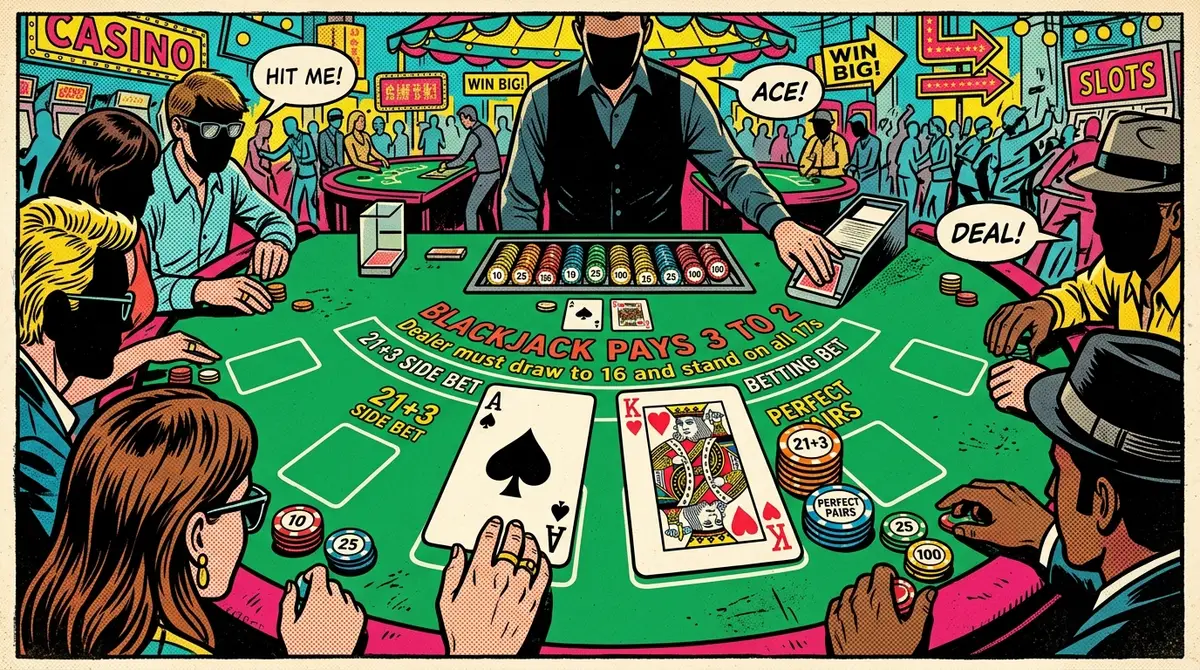
🎯 Core Side Bet Realities
- Massive Edge Discrepancy: While the base blackjack hand played with basic strategy has a house edge around 0.50%, side bets carry edges from 3.24% to nearly 17%.
- 21+3 Volatility: The 21+3 bet blends blackjack with three-card poker hands. Hit frequency is roughly 9.68%, meaning 9 out of 10 side wagers are lost outright.
- Insurance Is a Sucker Bet: Taking Insurance against a dealer Ace carries a 7.40% house edge in a 6-deck shoe—nearly 15 times worse than playing out the hand.
- Bankroll Erosion: Betting $5 on side bets alongside a $10 main wager accelerates expected hourly loss by more than 400%.
1. The Appeal and Cost of Blackjack Side Bets
Base Game 0.5% vs Side Bet 3%–17% House Edge
Blackjack is renowned as one of the fairest games on the casino floor. When adhering to strict mathematical charts, the casino’s statistical advantage shrinks to just 0.40%–0.60%. However, standard blackjack offers modest payouts: even-money 1:1 wins and 3:2 for a natural 21. Side bets were introduced by table game suppliers to satisfy player appetite for high-multiplier jackpots, offering payouts of 5:1, 25:1, and 100:1. The hidden compromise is a drastically higher house edge.
Why Casinos Feature Side Bets: Margin Expansion
For casino operators, the base blackjack game yields low theoretical margins. Side bets transform blackjack into a high-margin game similar to roulette (2.70%–5.26%) or Caribbean Stud (5.22%). Because side wagers are resolved rapidly during the initial deal without requiring complex decisions or time-consuming hits, they significantly boost casino revenue per round without slowing table speed.
Popular Blackjack Side Bets Comparison (6-Deck Shoe)
| Side Bet | Winning Condition | Top Payout | Hit Frequency | House Edge |
|---|---|---|---|---|
| 21+3 (Modern Graded) | Player 2 cards + Dealer upcard poker hand | 100:1 | 9.68% | 3.24% |
| Perfect Pairs | Player first 2 cards form a pair | 25:1 (or 30:1) | 7.47% | 5.79% – 6.11% |
| Insurance | Dealer has natural blackjack with Ace up | 2:1 | 30.87% | 7.40% |
| Buster Blackjack | Dealer busts (higher payouts for 5+ cards) | 250:1 (8-card bust) | 28.16% | 6.21% – 8.25% |
| Lucky Ladies | Player first 2 cards total 20 | 100:1 (Matched Qs) | 10.98% | 13.39% – 16.98% |
2. Most Common Blackjack Side Bets: Rules and Payouts
21+3: Combining Blackjack with Three-Card Poker
21+3 is by far the most popular side bet at both brick-and-mortar and live dealer online tables. It evaluates a three-card poker hand formed by your initial two cards and the dealer’s upcard. In standard European and American multi-deck shoes, winning hands pay as follows:
• Flush (5:1): Three cards of the same suit (probability 5.84%).
• Straight (10:1): Three cards of consecutive rank (probability 3.10%).
• Three of a Kind (30:1): Three cards of identical value, mixed suits (probability 0.50%).
• Straight Flush (40:1): Consecutive ranks of the same suit (probability 0.20%).
• Suited Trips (100:1): Three identical cards of the same rank and suit (probability 0.02%).
With a total house edge of 3.24%, 21+3 is among the least punitive side bets in the casino.
Perfect Pairs: Suited, Colored, and Mixed Pairs
The Perfect Pairs side wager pays if your initial two dealt cards have matching face values. Payout tiers depend on suit and color matching:
• Mixed Pair (6:1): Same rank, different color and suit (e.g., 7 of Spades + 7 of Hearts). Probability: 3.86%.
• Colored Pair (12:1): Same rank and color, different suit (e.g., King of Diamonds + King of Hearts). Probability: 1.93%.
• Perfect Pair (25:1 or 30:1): Identical rank and suit from separate decks (e.g., two Queens of Clubs). Probability: 1.68%.
Overall hit frequency is 7.47%, resulting in a house edge of 6.11% in a 6-deck shoe and 5.79% in an 8-deck shoe.
Insurance and Even Money: The Mathematical Trap
When the dealer shows an Ace, players are offered Insurance up to half their main wager, paying 2:1 if the dealer’s hole card is a 10-value card (10, J, Q, K). If the player has a blackjack, taking "Even Money" is mathematically identical to purchasing insurance. While intuitively appealing to protect a winning hand, probability proves that without an unusually high ten-rich deck count, Insurance is mathematically irrational.
Other Popular Side Bets: Buster and Lucky Ladies
Buster Blackjack pays whenever the dealer busts, rewarding larger multiples if the bust requires 5, 6, 7, or 8 cards. Lucky Ladies awards up to 100:1 if your first two cards form a total of 20 with Queens, and up to 1,000:1 for a pair of Queens of Hearts with a dealer blackjack. However, with house edges frequently topping 13%–17%, Lucky Ladies is one of the most expensive wagers in modern gaming.
3. Exact Shoe Math: The Expected Value of Insurance
Let’s calculate the exact expected value (EV) of an Insurance wager in a standard fresh 6-deck shoe (312 total cards) when the dealer shows an Ace, counting only the dealer’s Ace as a known card:
6 × 52 = 312 cards• Total 10-value cards (10, Jack, Queen, King):
6 × 16 = 96 cards• Known cards: 1 Ace (dealer) = 1 card visible
• Remaining unseen cards in shoe:
312 - 1 = 311 cards
• Losing cards (Non-tens remaining):
311 - 96 = 215 cards• Win Probability:
P(Win) = 96 / 311 = 30.868%• Loss Probability:
P(Lose) = 215 / 311 = 69.132%
EV = [P(Win) × (+$200)] + [P(Lose) × (-$100)]EV = (0.30868 × $200) - (0.69132 × $100) = $61.74 - $69.13 = -$7.39Resulting House Edge: 7.40% House Edge
Live Blackjack Tables at BC.GAME
Play classic 3:2 European and American live dealer blackjack with optional 21+3 and Perfect Pairs side bets. Remember to prioritize basic strategy. 18+, T&Cs apply.
4. Frequently Asked Questions
Does basic blackjack strategy apply to side bets?
No. Basic strategy strictly dictates actions for your primary two cards against the dealer upcard. Side bets resolve independently before or during the deal and cannot be optimized by hit or stand decisions.
What is the house edge on 21+3 in blackjack?
On standard 6-deck tables with graded poker payouts (paying up to 100:1 for suited trips), the 21+3 house edge is approximately 3.24%. Older paytables with a flat 9:1 payout carry a significantly higher house edge of 7.14%.
Should you ever take Insurance or Even Money?
Mathematically, no. In an uncounted 6-deck game, Insurance gives the casino a 7.40% house edge. Even Money on a natural blackjack simply takes insurance at the same negative expectation.
Which blackjack side bet has the highest payout?
Suited Trips in 21+3 pays 100:1, while Perfect Pairs of the same suit pays up to 25:1 or 30:1. Certain rare jackpots like Super 7s or Buster 8-card busts can award up to 250:1, accompanied by very steep house edges.
Can card counting beat blackjack side bets?
Certain side bets like Insurance become profitable at a True Count of +3 or higher. Specialized count systems exist for Over/Under 13, but online live dealer shoes are often reshuffled early, which limits counting edges.
Do side bets count toward casino bonus wagering?
Rarely. In almost all online casinos, table games contribute only 5% to 10% toward wagering, and many operators specifically exclude side bets from rollover calculations entirely.