


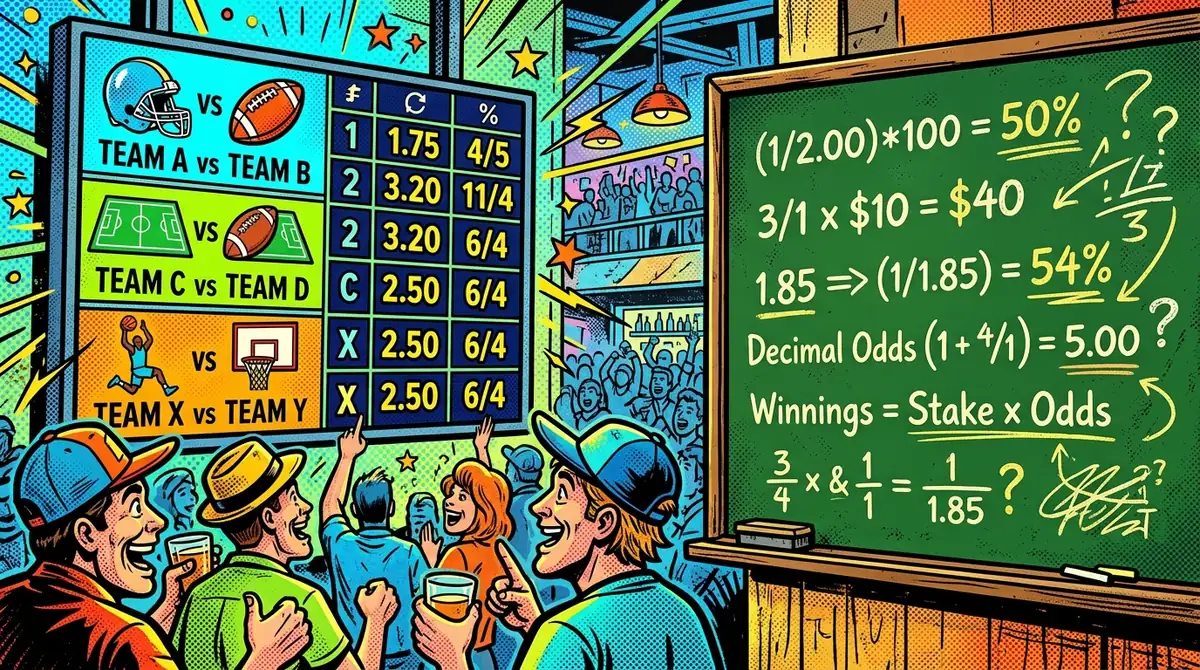
🎯 Key Takeaways for Smarter Betting Decisions
- Odds Represent Mathematical Probability: Every set of odds is fundamentally a numerical translation of an event's implied chance of occurring, adjusted downward to favor the house.
- Three Global Display Formats: Decimal (European), Fractional (British), and American (Moneyline) represent identical underlying math through different visual perspectives.
- The Bookmaker Margin (Overround): Sportsbooks never offer true mathematical odds. They price each market so that total implied probabilities exceed 100%, guaranteeing their operational commission.
- Discipline Over Intuition: Successful bettors identify value by calculating whether the true statistical probability exceeds the bookmaker's implied probability, while adhering to strict bankroll management principles.
1. Understanding the Core Concept: What Betting Odds Really Mean
When an online sportsbook or betting exchange publishes numbers next to a sporting event, novice bettors view those numbers purely as payout multipliers. Experienced analysts view them through a mathematical lens: as an expression of implied probability. Betting odds serve two simultaneous functions: they quantify how likely an event is deemed to happen, and they determine exactly how much cash you receive if your prediction proves correct.
Probability vs. Payout Ratio
The fundamental rule of odds pricing is an inverse relationship: the higher the probability of an outcome, the lower the published odds and the smaller the net reward. Conversely, an underdog with a slim statistical probability carries high odds, offering a substantial payout to offset the substantial risk. In a mathematically fair coin-toss scenario with zero house commission, each side has an exact 50% probability (0.50), translating to decimal odds of 2.00 (Even money).
Why Odds Shift in Real Time
Odds are rarely static. From the moment an opening line is established until the match kicks off, numbers fluctuate constantly. These movements are driven by two main factors: fresh information (such as tactical lineup announcements, sudden player injuries, or severe weather conditions) and incoming betting volume. If heavy financial stakes land on one side of a market, bookmakers systematically shorten those odds and lengthen the opposing odds to balance their liabilities and mitigate financial exposure.
2. The Three Primary Betting Odds Formats Explained
Depending on your geographic region or preferred online betting platform, odds are presented in one of three standardized formats: Decimal, Fractional, or American. Regardless of visual differences, they all describe the exact same underlying mathematical probabilities.
Decimal Odds (European Format)
Decimal odds are the dominant global standard across Continental Europe, Canada, Australia, and international online platforms. They express the total return for every $1 wagered, directly inclusive of your original stake. If you stake $100 on an outcome priced at 2.50, your total return is $250 ($100 stake + $150 profit). Because calculations require a single arithmetic multiplication, decimal odds are the most straightforward format for calculating complex bets and market overrounds.
Fractional Odds (British / Traditional Format)
Deeply rooted in United Kingdom horse racing and traditional British high-street bookmaking, fractional odds are written as a ratio: Numerator / Denominator (e.g., 5/2, 1/4, 11/10). Fractional odds display the net profit relative to the stake required. In 5/2 ("five-to-two"), the numerator (5) is the net profit won for every denominator (2) staked. Wagering $20 at 5/2 yields $50 in net profit plus the return of your original $20 stake, resulting in a $70 total payout.
American Odds (Moneyline Format)
Standard across the United States and North American sportsbooks, American odds revolve around a baseline stake of $100 and use positive (+) and negative (-) indicators. A negative number (e.g., -150) denotes the favorite and indicates how much cash you must stake to generate $100 in net profit. A positive number (e.g., +220) designates the underdog and shows how much net profit you collect from a $100 wager. A bet of -150 requires a $150 outlay to yield $100 profit ($250 total return), whereas a $100 bet at +220 generates $220 profit ($320 total return).
Odds Conversion Formulas & Bookmaker Overround Engine
To evaluate sports bets accurately, you must convert odds between formats and calculate the exact bookmaker margin built into the odds. Below are the precise mathematical formulas used in this guide:
Implied Prob % = (1 / Decimal Odds) * 100%
Converts decimal odds into percentage probability.
Margin = (sum(1 / Decimal_Odds) - 1) * 100%
Calculates total book percentage minus 100%.
Real-World Match Example: 3-Way Football Market (1X2)
Consider a top-tier European football match with the following three-way match betting odds: Home Win at 1.95, Draw at 3.40, and Away Win at 4.10. Let us compute the exact implied probabilities, the total book, and the bookmaker's true margin:
| Selection | Decimal Odds | Fractional Equivalent | American Equivalent | Implied Probability |
|---|---|---|---|---|
| Home Win (1) | 1.95 | 19/20 | -105 | 51.28% |
| Draw (X) | 3.40 | 12/5 | +240 | 29.41% |
| Away Win (2) | 4.10 | 31/10 | +310 | 24.39% |
| Total Market Book (Sum of Probabilities): | 105.08% | |||
| True Bookmaker Overround / Margin: | 5.08% | |||
Analytical Breakdown: In a perfectly fair, zero-margin world, the sum of all mutually exclusive outcomes equals exactly 100.00%. Here, the probabilities total 105.08% (1.0508). That surplus 5.08% represents the bookmaker's structural cut. The bettor faces an inherent mathematical drag analogous to the house edge in casino table games.
3. Comprehensive Odds Conversion Reference Matrix
To navigate global bookmakers seamlessly, bettors need to recognize standard odds equivalents across all three pricing formats alongside their corresponding implied probability benchmarks.
| Decimal Odds | Fractional Odds | American Odds | Implied Probability | Net Profit on $100 Stake |
|---|---|---|---|---|
| 1.20 | 1/5 | -500 | 83.33% | $20.00 |
| 1.50 | 1/2 | -200 | 66.67% | $50.00 |
| 1.80 | 4/5 | -125 | 55.56% | $80.00 |
| 2.00 | 1/1 (Evens) | +100 | 50.00% | $100.00 |
| 2.50 | 6/4 | +150 | 40.00% | $150.00 |
| 3.00 | 2/1 | +200 | 33.33% | $200.00 |
| 5.00 | 4/1 | +400 | 20.00% | $400.00 |
4. Identifying Mathematical Value: The Secret of Long-Term Success
The single most common mistake made by recreational sports bettors is attempting to predict winners rather than identifying mispriced odds. Profitable sports betting does not require picking every match correctly. It requires securing Expected Value (+EV), a concept fundamental to all gambling mathematics covered in our Hunter Academy lessons.
The Expected Value (+EV) Equation
A bet has positive expected value (+EV) whenever your estimated probability of an outcome is higher than the implied probability implied by the bookmaker's decimal odds. The mathematical equation for single bets is formulated as:
EV = (Estimated Probability * Potential Net Profit) - ((1 - Estimated Probability) * Stake)
For instance, if your quantitative statistical model indicates that an away football team has a 30% chance of winning, but the bookmaker offers decimal odds of 4.00 (which implies only a 25% probability), this wager carries substantial positive expected value. Over hundreds of such bets, the law of large numbers means that +EV wagers tend to show a profit over a large enough sample, even though you will lose many individual bets along the way. The catch is that your estimated probability must itself be accurate, which is the hard part.
The Compounding Cost of Accumulators (Parlays)
Accumulator bets, also known as parlays or combo tickets, lure recreational players with massive payout multipliers. However, from a mathematical standpoint, combining selections multiplies the bookmaker margin at every leg. If you combine four selections, each carrying a 5% bookmaker margin (payout ratio of 95%), your net market payout efficiency drops dramatically:
Overall Combo Payout = 0.95 * 0.95 * 0.95 * 0.95 = 0.8145 (18.55% Bookmaker Margin)
While a single match bet incurs roughly a 5% margin, a 4-leg accumulator subjects your stake to an 18.55% operator edge. For long-term capital preservation, disciplined bettors focus predominantly on single-line wagers backed by rigorous bankroll sizing.
5. Practical Checklist: How to Compare Odds and Protect Your Bankroll
Before placing any sports wager, apply this rigorous operational checklist to protect your capital and extract optimal value from every betting line:
Calculate the Market Margin Before Betting
Never bet on high-margin markets blindly. Convert all selections to implied percentages and verify the total book. If the margin looks high for a mainstream football, basketball or tennis market, compare prices at other sportsbooks. A difference between odds of 1.90 and 1.95 represents a 2.6% difference in your net return on winning wagers.
Compare Prices Across Bookmakers
Different sportsbooks operate with varying risk models, regional customer biases, and margin structures. Where it is legal and permitted for you, comparing prices across several licensed operators lets you see the best published price for a given market. Comparing prices before every bet reduces unnecessary margin drag, but it does not remove the bookmaker margin or make any bet safe.
Enforce Fixed Unit Staking and Strict Loss Limits
Even with accurate probability models, negative variance is inevitable. Risking inconsistent sums or doubling down to chase losses leads straight to ruin. A commonly used guideline is to risk no more than 1% to 2% of your sports bankroll on a single ticket. For comprehensive guidelines on setting daily session limits and self-exclusion tools, consult our dedicated responsible gambling guide.
Betwinner: 100% Welcome Bonus up to €100 for Sports and Esports
A 5x rollover applies to the bonus balance. Minimum odds, expiry and eligible markets are set by the promotion, so read the full terms on the official promo page before depositing. 18+, T&Cs apply.
Frequently Asked Questions About Betting Odds
How do betting odds reflect the probability of an outcome?
Betting odds represent an inverse relationship to probability: lower odds signify a higher likelihood of winning with a smaller profit, while higher odds reflect an underdog with lower probability and higher potential return. Converting decimal odds using (1 / Odds) * 100% reveals the implied probability assigned by the bookmaker.
What is the simplest way to calculate payouts from decimal odds?
Multiply your stake by the decimal number to determine total return: Total Payout = Stake * Decimal Odds. To determine your net profit alone, subtract the original stake: Net Profit = Stake * (Decimal Odds - 1). For example, a $50 wager at 2.40 yields $120 total payout and $70 net profit.
Why do the combined probabilities in a betting market exceed 100%?
The total of all implied probabilities in any betting market exceeds 100% due to the bookmaker margin, also known as the overround or vigorish. This built-in mathematical cushion ensures the sportsbook extracts a profit margin regardless of which specific outcome wins.
How does bookmaker margin differ from casino house edge?
Both represent the operator's mathematical advantage over the bettor. In casino games like roulette or blackjack, the house edge is fixed by fixed game rules and payout structures. In sports betting, the margin fluctuates across events, leagues, and market liquidity as bookmakers price in risk and liability.
How do American plus and minus odds work?
American odds use positive (+) and negative (-) signs. A minus sign indicates the favorite and shows how much money you must wager to win $100 net profit (e.g., -150 requires a $150 bet to earn $100). A plus sign indicates the underdog and shows the net profit earned on a $100 wager (e.g., +200 returns $200 profit on a $100 bet).
What is considered a fair bookmaker margin on major sporting events?
Margins differ widely between bookmakers and markets. Mainstream markets on top leagues usually carry the lowest margins, often in the low single digits at competitive sportsbooks, while niche leagues, prop bets and parlays tend to carry noticeably higher ones. Always calculate the margin of the specific market you are looking at.