


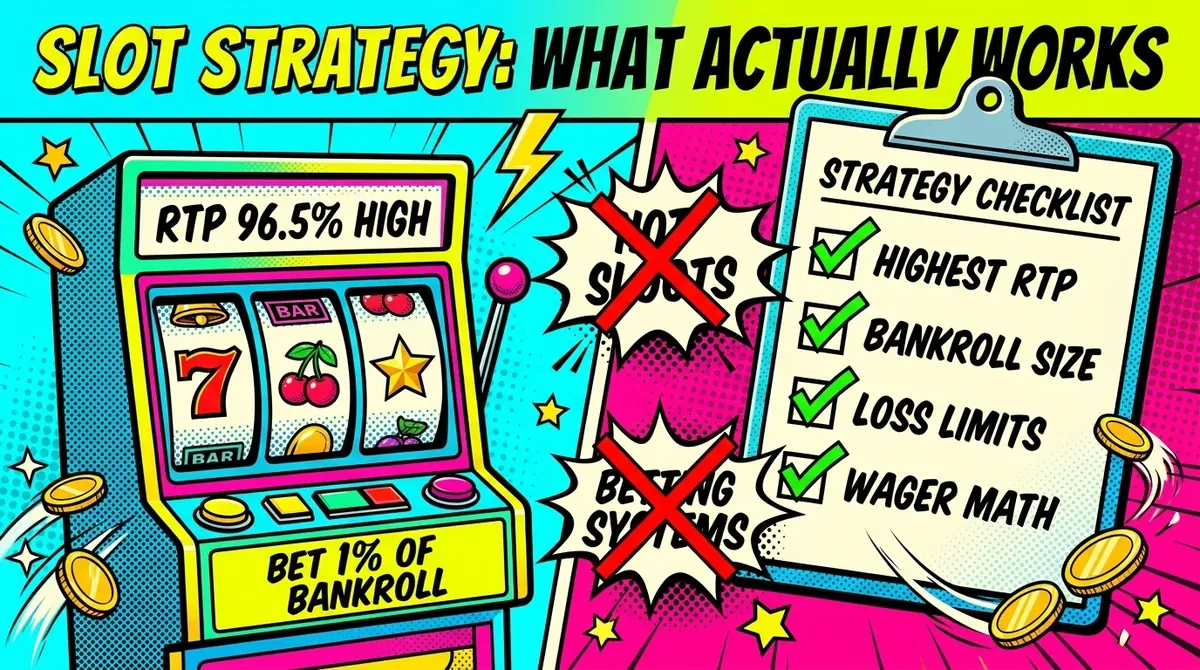
🎯 The 6-Step Slot Strategy in 30 Seconds
- Check the RTP version in the paytable before you spin. The same game can run at different RTPs at different casinos.
- Match volatility to your budget: small bankroll means low or medium volatility.
- Bet about 1% of your session bankroll per spin, so a cold streak does not end the session in minutes.
- Set a loss limit and a win target before you start, and stop when you hit either one.
- Do the wagering math before accepting a bonus. Many bonuses lose value on average.
- Ignore systems and myths: betting progressions, "hot" machines and lucky hours do not change the odds.
1. Is There Really a Strategy to Win at Slots?
Not in the sense most people hope for. A licensed online slot uses a random number generator (RNG): each spin is independent of the previous one, and the outcome is fixed the moment you press the button. There is no pattern to read, no timing trick and no way to influence where the reels stop.
On top of that, every slot is built with a house edge. A slot with 96% RTP keeps, on average, 4% of everything you wager over the long run. Short sessions can end in profit thanks to variance, but the longer you play, the closer your result gets to that average.
So a realistic slot strategy is not about winning more often. It is about losing less per spin, lasting longer, and only taking bonuses that make mathematical sense. Treat slots as paid entertainment with a known average price.
2. Pick the Highest RTP Version of the Game
This is the single biggest lever you have, and most players never check it. Major studios such as Pragmatic Play and Play'n GO ship many of their games in several RTP configurations, and the casino chooses which one to run. The same Book of Dead or Sweet Bonanza can be set noticeably lower at one site than at another.
How to check: open the game, tap the "i" / paytable / game rules button and look for "RTP" or "theoretical return". If the number is lower than the figure listed by the game provider, you are playing a reduced version.
Expected loss = Total amount wagered × (100% − RTP)
Total amount wagered = number of spins × bet per spin. It is an average over many sessions, not a prediction for one session.
| Same session: 500 spins × $1 | House edge | Average loss |
|---|---|---|
| 96.5% RTP version | 3.5% | −$17.50 |
| 94.0% RTP version | 6.0% | −$30.00 |
| 91.0% RTP version | 9.0% | −$45.00 |
Same game, same bets, same entertainment, but the low version costs you more than twice as much on average. Our RTP & volatility lesson goes deeper, and our slot list shows the top RTP of popular games.
3. Match Volatility to Your Bankroll
RTP tells you the average price. Volatility tells you how bumpy the ride is. Two slots with identical RTP can behave completely differently: one pays small amounts often, the other goes hundreds of spins with little return and then pays a large multiplier.
Choose low or medium volatility. Wins are smaller but more frequent, so your balance lasts longer and swings less.
High or extreme volatility games (e.g. Tombstone RIP, San Quentin) need a much larger bankroll relative to your bet. Expect long dry streaks.
4. Size Your Bets: the 1% Rule
Bet size does not change the house edge, but it decides how many spins your bankroll can survive. A simple rule: bet roughly 1% of the money you have set aside for the session.
- $100 session budget → about $1 per spin
- $200 session budget → about $2 per spin
- On high-volatility games, go lower (0.5%) to survive the dry spells.
Full explanation with examples: The 1% Bankroll Rule & Bet Sizing.
5. Set a Loss Limit and a Win Target Before You Start
Because the edge works over time, the decision that matters most is when you stop. Decide both numbers before the first spin, write them down, and treat them as rules, not suggestions:
- Loss limit: the amount you are fine losing tonight. Once it is gone, the session is over. Never top up to "win it back".
- Win target: for example +50% of the session budget. If you hit it, cash out the profit and stop.
- Time limit: set a phone timer. Long sessions are where the house edge does its work.
More on this in Stop-Loss & Take-Profit Rules. If stopping feels hard, read our responsible gambling page.
6. Bonuses: Do the Wagering Math First
A bonus looks like free money, but you usually have to wager it many times before you can withdraw. Every wagered dollar carries the house edge, so the wagering requirement has a cost. Compare that cost with the bonus amount:
| Wagering | Turnover needed | Average cost (3.5%) | Average value of the bonus |
|---|---|---|---|
| 20x | $2,000 | $70 | about +$30 |
| 35x | $3,500 | $122.50 | about −$22.50 |
| 50x | $5,000 | $175 | about −$75 |
Simplified average. Real results also depend on max bet rules, game contribution, win caps and volatility. If wagering applies to deposit + bonus, the turnover doubles.
What this means in practice:
- Lower wagering is worth much more than a bigger headline percentage.
- Wager-free cashback and no-wagering free spins are the cleanest value.
- At 35x and above, treat a bonus as extra playtime, not as expected profit.
- Always respect the max bet rule while a bonus is active, or winnings can be voided.
7. Slot Myths That Cost Players Money
Spins are independent. A slot that has not paid for 200 spins is not more likely to pay on spin 201.
No betting system changes the house edge. Progressions only make losses arrive faster and bigger. They are especially pointless on slots, where results are not even-money.
The RTP is set in the game configuration, not by the clock. Time of day does not change the odds.
The result is decided when the spin starts. Quick stop only shortens the animation.
Bonus buy features sometimes have a slightly different RTP and always much higher variance per round. Read Bonus Buy Math before using them.
8. Practice in Demo Mode First
Before spending real money on a new game, play it in demo mode. You will not learn to "beat" it, but you will see how volatile it feels, how often features trigger and whether its bet range fits your budget. Popular games to try: Gates of Olympus 1000, Sweet Bonanza, Book of Dead.
Want to try real-money spins without your own deposit?
Riobet gives new players 70 no deposit free spins. Winnings carry 35x wagering, so treat them as a free test of the casino, not as guaranteed cash. 18+, T&Cs apply.
✅ Pre-Spin Checklist
- RTP in the paytable matches the provider's top version.
- Volatility fits your budget.
- Bet is about 1% of the session bankroll.
- Loss limit, win target and time limit are set.
- If using a bonus: wagering, max bet and expiry are checked in the calculator.
- Only money you can afford to lose. 18+.
Slot Strategy FAQ
Is there a strategy to win at slots?
No strategy can make slots profitable in the long run, because every spin is random and the game has a built-in house edge. What you can control is your average loss (by choosing high RTP versions), how long your bankroll lasts (bet sizing and volatility) and whether a bonus is worth claiming.
What is the best slot strategy?
Play the highest RTP version of a game, choose volatility that fits your budget, bet around 1% of your session bankroll, set loss and win limits in advance, and only take bonuses with low wagering.
Do betting systems like Martingale work on slots?
No. Betting systems do not change the house edge. Increasing bets after losses only increases how much you can lose in a short time.
Does the time of day affect slot payouts?
No. A slot's RTP is fixed in its configuration. Every spin has the same odds regardless of the time or how recently the game paid.
What RTP should I look for?
As a rule of thumb, 96% or higher. More importantly, check that the casino runs the provider's top RTP version of the game, since many games exist in several configurations.