


🎯 Key Takeaways
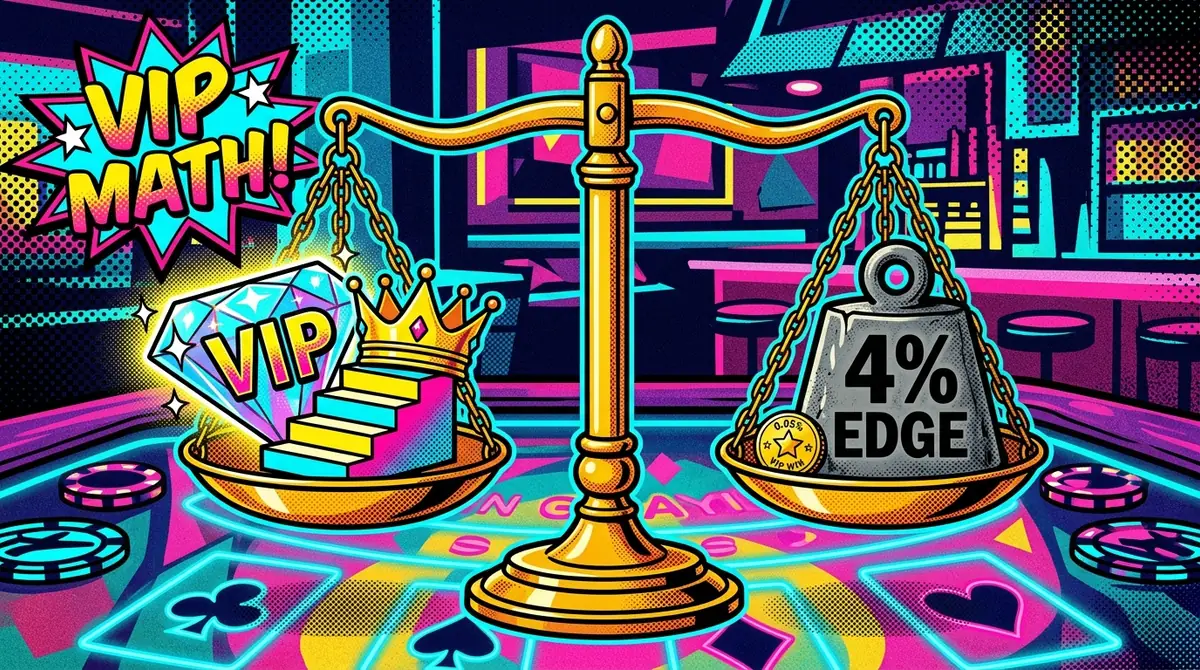
- Points have a cash price. Points earned per unit wagered multiplied by the cash value of one point gives your real return rate. In the example below it is 0.05% of turnover.
- The return is small next to the edge. On a 96% RTP slot the expected loss is 4% of turnover, so a 0.05% to 0.30% loyalty return offsets only a small share of it.
- Tiers change perks, not odds. RTP and house edge are identical for every level.
- Read the decay rules. Tier resets, point expiry and wagering on level-up bonuses decide whether a program is worth anything.
- Never bet more to climb a level. Extra turnover costs the house edge on every unit.
1. Loyalty Program vs VIP Program: Two Different Things
Casino sites use loyalty program and VIP program as if they were one thing, but they usually describe two layers. The first is an automatic ladder. Every real-money bet earns points or experience, and enough points move you up a level. The second is a relationship layer on top: an account manager, custom offers, higher limits and invitations. Most players only ever meet the first layer.
Programs typically run on one of three engines. Knowing which one you are in tells you what the reward really is:
- Points shop: you collect points and exchange them for bonus money, free spins or cash at a fixed rate.
- Rakeback or cashback tiers: a percentage of wagering or net losses is returned, and the percentage rises with your level. See the glossary entry on cashback for the basic terms.
- Invite-only VIP: offers are set by a manager and can change from month to month. There is usually no public rate to calculate.
Everything in this guide applies most directly to the first two, because they have a published rate you can put numbers on.
2. What a Program Is Made Of
Whatever the branding, almost every program is built from the same parts. When you read the terms, look for each of these:
- Earn rate: how many points or XP you get per unit wagered, often different for slots, live games and table games.
- Tier thresholds: the points or turnover needed for each level, and the period in which they are counted.
- Conversion rate: how many points make one unit of cash or bonus money.
- Level-up rewards: one-off bonuses when you reach a tier. Check whether they carry wagering, which is explained in the bonus wagering guide.
- Recurring perks: weekly or monthly bonuses, rakeback, cashback, free spins.
- Service perks: priority support, higher withdrawal limits, a personal manager. Their value depends on how you play. For payout limits in general, see withdrawal methods.
- Decay rules: point expiry, tier review periods and the conditions for dropping a level.
The first three decide the cash value. The last one decides whether you keep it.
3. The Loyalty Value Formula: What a Point Is Worth in Cash
Marketing shows you a tier name. The number that matters is the effective return rate: how much cash comes back per unit you wager. You can compute it from two numbers in the terms.
Return rate = (points per unit wagered) × (cash value per point)
Use the same currency unit for both numbers. If points convert to bonus money with wagering attached, the true value is lower still.
Worked example
Suppose a program pays 1 point for every $20 wagered on slots, and 100 points can be exchanged for $1. The terms here are an invented example, not a specific casino.
- Points per $1 wagered: 1 ÷ 20 = 0.05 points.
- Cash value of one point: $1 ÷ 100 = $0.01.
- Return rate: 0.05 × $0.01 = $0.0005 per $1 wagered = 0.05%.
- Check: $2,000 of wagering earns 100 points, which is worth $1. And $1 ÷ $2,000 = 0.05%.
Now compare that with the cost of playing. On a slot with 96% RTP the house edge is 4%, so wagering $2,000 has an expected loss of $2,000 × 0.04 = $80. The $1 from points returns 1.25% of that expected loss (1 ÷ 80). The points are a rounding error. They do not change the result of the session.
Higher tiers do better, but still sit in a narrow band. The table below applies four illustrative rebate levels to $10,000 of slot wagering. Expected loss is $10,000 × 4% = $400 in every row.
| Tier (illustrative) | Rebate on turnover | Rebate on $10,000 wagered | Expected slot loss at 96% RTP | Share of the loss returned |
|---|---|---|---|---|
| Entry | 0.05% | $5.00 | $400.00 | 1.25% |
| Mid | 0.10% | $10.00 | $400.00 | 2.50% |
| High | 0.20% | $20.00 | $400.00 | 5.00% |
| Top | 0.30% | $30.00 | $400.00 | 7.50% |
Even the illustrative top tier returns 7.5% of the expected loss. The other 92.5% is still on the table. To learn how RTP and the edge relate, see RTP and volatility.
4. Chasing the Next Tier: Do the Maths First
The most common mistake with loyalty ladders is raising your stakes to reach the next level. Take an invented tier that needs $50,000 of wagering per month and pays a 0.30% rebate, while the tier below pays 0.20%. Suppose you normally wager $10,000 a month.
- Staying at $10,000: expected loss $400, rebate at 0.20% = $20, net expected result = −$380.
- Pushing to $50,000: expected loss $2,000, rebate at 0.30% = $150, net expected result = −$1,850.
- Extra expected cost of chasing the tier: $1,850 − $380 = $1,470, in exchange for $130 more rebate ($150 − $20).
The perks of the higher tier would have to be worth well over a thousand dollars to justify that. The better question is whether you would play this volume anyway, and with what budget. That is what bankroll management and stop-loss rules are for.
Variance matters too. Expected loss is an average over long play. In a short period you can win or lose far more than the formula shows, and the loyalty return does not change that.
5. Where Points Quietly Disappear
Two players can have the same tier name and very different value, because of terms that are easy to skip:
| Clause | What it means | What to look for |
|---|---|---|
| Game weighting | Slots may earn full points, while table and live games earn a fraction or nothing | The contribution table, often a separate page |
| Bonus-money bets | Bets made with bonus funds often earn no points | Wording such as "real money only" |
| Point expiry | Unused points can be cancelled after a period of inactivity | The number of days, and what resets the timer |
| Tier review period | A level may be held only for a month or a quarter | Whether you must repeat the turnover to keep it |
| Wagering on rewards | Level-up bonuses and exchanged points can carry rollover | The multiplier, and the maximum bet while it is active, see the max bet rule |
| Withdrawal terms | Reward funds may have a cap on what can be withdrawn | Maximum cashout and any restrictions on the reward |
If you hold unfinished bonus balances, the loyalty terms can interact with them. The non-sticky bonus guide explains why the order in which funds are used matters.
6. VIP Hosts, Gifts and Higher Limits
Invite-only VIP tiers feel different, because the offers come from a person. A manager may offer a custom bonus, a deposit match, a gift or a higher withdrawal limit. These can be useful. Treat each offer as you would any other promotion: ask for the written terms, find the wagering requirement and the maximum bet, and decide whether the offer fits the budget you already had.
A few things are worth keeping straight:
- Higher limits are not a reward. They raise how much you can lose in a day, not your odds.
- An invitation is not a verdict on you. It usually reflects how much you have deposited or wagered.
- Gifts and trips are marketing. They are not free; they are designed to encourage more play.
- You can say no. You can decline offers, ask for fewer messages, or ask the casino to remove you from VIP marketing.
- Verification still applies. A VIP label does not skip identity checks. See the KYC verification guide for what is normally requested and why.
7. A Short Checklist Before You Care About Any Tier
- Find the earn rate and the conversion rate, then compute the return rate with the formula above.
- Check which games earn points and which earn none.
- Find out whether points expire and how a tier is kept or lost.
- Check whether rewards carry wagering, a maximum bet or a cashout cap.
- Decide your budget and limits first. Do not let a progress bar set the stake.
- Use the casino’s own limit tools, such as deposit, loss and time limits, and take breaks if play stops being fun. The responsible gambling page lists support organisations.
To test a specific reward against your own numbers, use the wager calculator.
Run the numbers on your own bonus
Enter the bonus, the wagering multiplier and the game RTP to see the expected cost before you accept it. 18+.
8. Frequently Asked Questions
How do casino loyalty points work?
Most casinos award a fixed number of points for each unit wagered, for example 1 point per 20 units on slots. Points are then exchanged for bonus money or cash at a published rate, and they usually also count toward your tier. To see the real value, multiply the points earned per unit wagered by the cash value of one point. The result is normally a fraction of one percent of turnover.
Are casino VIP programs worth it?
They can be worth a little if you already play regularly, because rewards such as rakeback or cashback return a small share of expected losses. They are not worth it as a reason to bet more. Every extra unit wagered costs you the house edge, while the loyalty return on that unit is typically far smaller than the edge.
What is the difference between a loyalty program and a VIP program?
A loyalty program is open to everyone and runs automatically: you collect points and move up levels. A VIP program is usually invite-based or starts at a higher tier, and adds a personal account manager, higher limits and custom offers. Some casinos use one name for both, so read the terms rather than the label.
Do bonus funds or table games earn loyalty points?
It depends on the terms. Many casinos award full points only on slots, reduce points on live dealer and table games, and award nothing for bets made with bonus funds or on excluded games. Check the contribution table in the loyalty terms before assuming that all play counts equally.
Can I lose my VIP level?
Yes. Many programs evaluate tiers over a rolling period such as a month or a quarter. If your turnover falls below the tier requirement, you can be moved down and lose its perks. Points can also expire after a set period of inactivity.
Does a higher VIP tier mean better odds?
No. A tier changes your perks, not the maths of the games. RTP and house edge stay the same on every spin and every hand. A higher tier may give you better rewards, higher limits and faster support, but your expected result per bet does not improve.